Technology
The CO₂ platform, part by part.
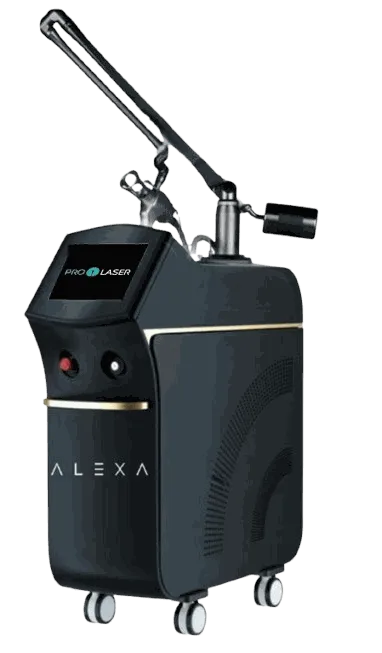
A 10,600 nm CO₂ source, a mirror-based articulated arm, a fractional scanner and a touchscreen: here is how Alexa turns one wavelength into treatment strategies.
01 · Wavelength
10,600 nm
Water is the chromophore. At 10,600 nm, energy is absorbed in a thin layer of water-rich tissue and turns into heat almost instantly.
That photothermal effect splits in two: ablation (water vaporizes and a micro-column of tissue is removed) and coagulation (residual heat denatures protein, seals small vessels and drives collagen remodeling). The operator controls the balance between them.
This is fundamentally different from pigment lasers or IPL: the target is water, not pigment — which is what makes CO₂ a precise resurfacing and soft-tissue tool.
02 · Beam delivery
A 7-joint articulated arm.
The beam travels through air, mirror to mirror, inside a weight-balanced arm with a 130 cm working radius.
- Consistent beam quality and delivered power
- No disposable fiber for standard articulated-arm procedures
- Precise aiming with a 650 nm red aiming beam
- Compatible with the fractional scanner and surgical handpieces
Like any optical path, the arm requires maintenance and output verification per manufacturer guidance.
03 · Mode strategy
Shallow, Deep, Hybrid.
The fractional scanner lays down a grid of columns; depth and density decide what the treatment does to the skin — and to the patient’s calendar.
Illustrative, not to scale. These are not named software presets: parameters are set by the clinician and taught in training.
04 · The six dosimetry levers
Every treatment is built from six levers.
Density and depth are the two big dials for downtime and risk. Clinical training teaches how to combine them.
Power
Energy delivery rate: more power, faster and deeper ablation.
Dwell time
How long each spot is energized: longer means more ablation and wider coagulation.
Density
How much of the area is treated: more correction, but more recovery.
Depth
How far each column reaches: surface refresh or deeper remodeling.
Passes
Cumulative depth and thermal load.
Scan shape
Geometry and sequencing: coverage on large areas, precision on small ones.
05 · Specifications
Verified specifications.
From Pro 1 Laser’s controlled technical documentation. Configuration details (handpieces, accessories) are confirmed on the quotation.
- Wavelength
- 10,600 nm (10.6 µm) CO₂
- Treatment modes
- Fractional and ablative
- Configurations
- Alexa Aesthetic (40 W) · Alexa Pro MVP 7 (60 W)
- Emission modes (40 W)
- Continuous 0.5–40 W · pulsed 0.5–30 W · superpulse 0.5–15 W
- Beam delivery
- 7-joint weight-balanced articulated arm, 130 cm working radius
- Fractional scanner
- Scan field up to 30 mm; customizable scan shapes
- Interface
- Colour touchscreen
- Aiming beam
- 650 nm red diode
- Safety
- Safety interlock; scanner-error warning; Class 4 laser
- Licence
- Health Canada MDL 114909, Class III
06 · Handpieces & pathways
One source, several applicators.
Fractional scanner
Resurfacing, texture, scars and photoaging. Learn more
Surgical handpieces
Focused or defocused beam for selected soft-tissue procedures. Learn more
Alexa Femme™
Dedicated 360° applicator architecture for the women’s-health pathway. Learn more
Alexa Follicle™
Scalp-focused fractional pathway for hair-restoration programs. Learn more
How large is the Alexa scanner?
The fractional scanner covers a scan field up to 30 mm, with customizable scan shapes set on the touchscreen. The exact dimensions of each shape are confirmed by the product team.
Why an articulated arm instead of a fiber?
10,600 nm energy does not travel through standard silica fibers. The articulated arm carries the beam through precision-aligned mirrors: good beam quality, consistent power and no disposable fiber for standard procedures. It requires appropriate maintenance and calibration.
What is the difference between the 40 W and 60 W configurations?
Alexa Aesthetic (40 W) covers aesthetic resurfacing and routine procedures. Alexa Pro MVP 7 (60 W) adds power for practices with more demanding or higher-volume workflows.
Are Shallow, Deep and Hybrid preset modes?
No. They are planning strategies the clinician builds with depth and density controls. Exact on-screen mode names can be confirmed with the product team, and parameters are taught in clinical training.
Ready to see what Alexa CO₂ could add to your practice?
Get a written quotation for your configuration, or book a remote or in-person demonstration with a Pro 1 Laser product specialist.